For many income-oriented investors October 31, 2006 will forever be etched in their brains. That was the day that our Federal Finance Minister lowered the tax boom and ended the tax arbitrage of income trusts. The market reacted by slicing about 17% from market prices of trusts to reflect the tax impact of the announcement. Despite the massive outcry at the time – and since – it’s hard to find reasons for trust investors to shed any tears.
After-tax Cash Flow
The tax-preferred cash flow – trusts’ main attraction – that income trust investors cherished has not changed for taxable investors. Previously, trusts paid out enough cash so that the businesses paid no tax at the trust level. Rather, investors who received cash payouts in taxable accounts would bear all of the tax liability. The tax change made those businesses formerly in trust form pay taxes on their net income.
As a result, investors now pay much less tax on the payouts received in a taxable account. The net effect, generally, is the same amount of after-tax cash flow.
Total Return
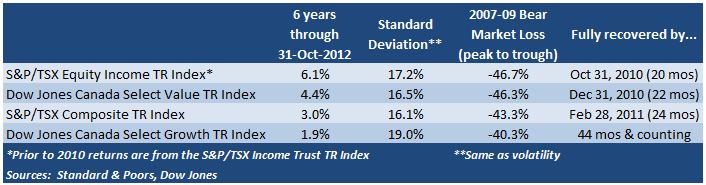
In the six years since the announcement, we can gauge the performance of this market segment by linking the old S&P/TSX Income Trust Total Return Index and the current S&P/TSX Equity Income Total Return Index. That combo saw returns of about 6% per year for the six years through October 31, 2012. By comparison, dividend stocks (measured by the Dow Jones Select Dividend Index) rose by 4% per year. The S&P/TSX Composite Total Return Index – the broader Canadian stock benchmark – saw returns of about half of trust returns.
See the table appended to this post for a summary of risk and return since the tax change was announced.
Risk & Volatility
Returns cannot be meaningfully examined without the context of risk. And over the past six years, the segment formerly known as income trusts has not demonstrated much different risk characteristics than other groups of Canadian stocks.
Trusts were slightly more volatile – as measured by standard deviation – than the broader market and other dividend stocks but not meaningfully so. And while trusts suffered marginally deeper losses in the worst of the financial crisis, they rebounded more quickly than the broader market, dividend stocks and value stocks.
Overall, income trusts had no more total risk than other groups of Canadian stocks.
Despite changing the income trust tax regime, the after-tax cash paid out by this group of stocks did not change; they produced significantly higher total returns over the past six years than other domestic stocks (even with the initial 17% drop) and they’ve exhibited roughly the same risk as other stocks.
Judging by the regular activity at the blog of the Canadian Association of Income Trust Investors, income trust investors continue to hold a grudge against the federal conservatives. But at least they can sooth themselves with a level of performance that disproves their core complaint.
Regardless of how you acquired your wealth, there’s one thing all investors have in common—a…
An architect wouldn’t design a custom home for a family without first asking many questions…
Financial planning is the first step in a comprehensive discovery phase at HighView Financial Group.…
A “fixed asset” is a long-term tangible asset that is not expected to be consumed…
One of the core principles at HighView is to understand the purpose of the portfolio.…